
Fears are growing over Iran’s nuclear capabilities and how it could threaten the world as violence escalates in the Middle East.
The killing of Supreme Leader Ayatollah Ali Khamenei and fresh waves of strikes by the US and Israel on Iran have increased the nuclear risk, experts warn.
Donald Trump said the aim of the military operation was to “ensure that Iran does not obtain a nuclear weapon”. But a weakened Iranian regime, already striking back in the region, may seek to use every tool in its arsenal to respond.
There is also the risk of Iran’s nuclear research, material and scientists making their way into the wider world, if Iranian society breaks down, creating a far more unsafe world.
Nuclear weapon ambitions
According to the International Atomic Energy Agency (IAEA), Iran maintains a stockpile of 440.9kg of uranium enriched up to 60 per cent purity, which is the level just below weapons grade.
Trump previously claimed that last summer, US-Israeli strikes on Iran’s nuclear facilities completely destroyed its nuclear weapons programme, but the recent attacks imply otherwise.
Darya Dolzikova, senior research fellow with the Royal United Services Institute’s Proliferation and Nuclear Policy programme, said that the strikes in June 2025 will have degraded the materials needed to make a nuclear weapon.
But she added that “given the last 72 hours, I can see why whoever ends up in leadership – whether it’s some kind of Islamic Revolutionary Guard Corps (IRGC) hardline coalition or if it’s somebody more friendly towards engagement with the West – either way, there’s certainly plenty of incentive for them to look to the development of a nuclear weapon after this”.
With Khamenei gone, if the IRGC ends up taking control, “then we might see more of an incentive to actually be more aggressive on the nuclear side,” Dolzikova said.
While “the incentives might be there for whatever government comes in next, I think materially it would be very difficult,” she said, but added that Khamenei was the “backstop” on Iran’s nuclear programme. He “wasn’t the most hardline element of the system”.
Dr H.A. Hellyer, a senior fellow at Rusi, told The i Paper that “the immediate risk of Iran using a nuclear weapon in retaliation is basically zero. There is no deployable weapon”.
However, in the long term, there is a risk that any new regime could restart work to build one.
Strikes on nuclear facilities
The latest Israeli and US strikes have largely focused on eliminating Iran’s political and military leadership, not its nuclear facilities, which were the main targets during last year’s aerial campaign.
But on Monday, Iran’s ambassador to the IAEA claimed that the US and Israel had attacked the uranium enrichment facility in Natanz over the weekend.
The nuclear watchdog said there were no signs the nuclear facilities had been attacked.
“We have no indication that any of the nuclear installations, including the Bushehr Nuclear Power Plant, the Tehran Research Reactor or other nuclear fuel cycle facilities have been damaged or hit,” the IAEA’s director general, Rafael Mariano Grossi, said.
The IAEA has also urged restraint to avoid any nuclear safety risks to people in the country and the wider region. So far, it says there is no evidence of “radiological impact” from the recent US-Israeli attacks, but added that it will keep monitoring the situation.
Iran’s historic nuclear programme
Iran’s nuclear programme began with the help of the US in 1957, under President Dwight Eisenhower’s ‘Atoms for Peace’ Program. It was initially a civil nuclear cooperation with the US-allied Shah of Iran, which paved the way for the country’s first nuclear research reactor.
This cooperation ended with the Islamic Revolution in 1979. After the death of Ayatollah Ruhollah Khomeini in 1989, Khamenei expanded the country’s nuclear activities.
In 2015, Iran signed an agreement to limit its nuclear programme in return for lifting crippling economic sanctions. However, in 2018, Trump pulled the US out of the deal and reimposed sanctions on the country.
After the US and Israeli strikes last year, all international cooperation was suspended, and since then, the IAEA has not been able to access Iran’s four declared enrichment facilities.
Nuclear material on the black market
Another major concern is that Iranian nuclear material and expertise could fall into the wrong hands, or, if the Iranian state collapses entirely, be sold on the black market.
“If central authority were to fragment, control over fissile material, sensitive technology, or specialised expertise could weaken,” Hellyer said.
“Nuclear scientists cannot simply ‘disappear,’ but in a severe breakdown scenario, knowledge transfer — or illicit procurement networks — become conceivable,” he said.
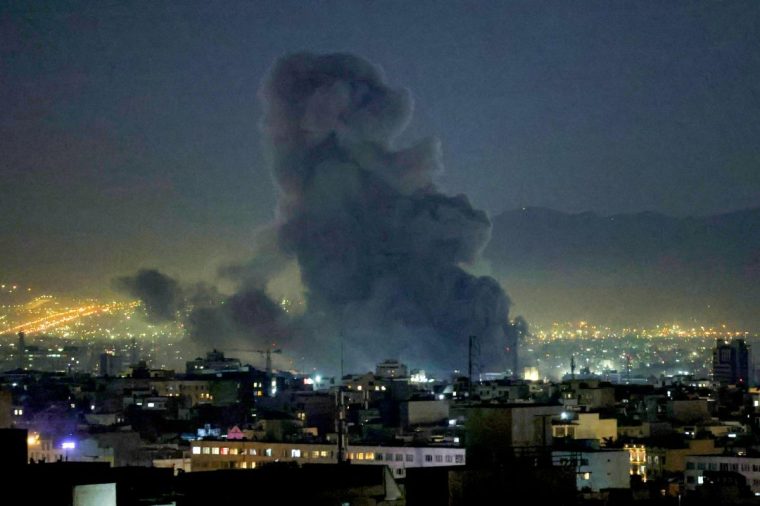
If there is a collapse of security at Iran’s nuclear facilities the movement of nuclear material on the black market could be possible, although enriched uranium is “monitored, heavy, and traceable,” said Hellyer. “There is no evidence yet of massive cracks in the Iranian regime that would mean its demise.”
In January, David Albright, a former nuclear weapons inspector in Iraq and founder of the nonprofit Institute for Science and International Security, said it was possible that Iran could “lose the ability to protect its nuclear assets” if the country descends into turmoil.
He suggested that Tehran’s highly enriched uranium stockpile “would be the most worrisome” aspect.
Dolzikova said that security at Iran’s known facilities is something “we need to keep an eye on”, especially in a region “where we know there are non-state actors that have previously expressed an interest”.
“If the nuclear programme is fully shut down, then hypothetically, we could run the risk of unemployed scientists being employed elsewhere,” she said.
Other countries’ nuclear weapons
Developments in Iran have heightened concerns around nuclear weapons.
French President Emmanuel Macron is expected to set out on Monday how France will use its 300 nuclear warheads to protect Europe. This marks a turning point in the continent’s security debate, as it looks to bolster its own defence capabilities and reduce its reliance on US security guarantees.
“What we are experiencing demonstrates that in the world to come, power and independence will be two indispensable forces for dealing with the proliferation of threats,” a member of Macron’s team told AFP.
Meanwhile, nations feeling threatened by the West, including the likes of North Korea, may look to increase their own nuclear capabilities after seeing what has happened with Iran.
 Bank SWIFT Code | agus setiawan | kodepos